
The Conquest of Granada (1492): The End of Muslim Rule in Spain
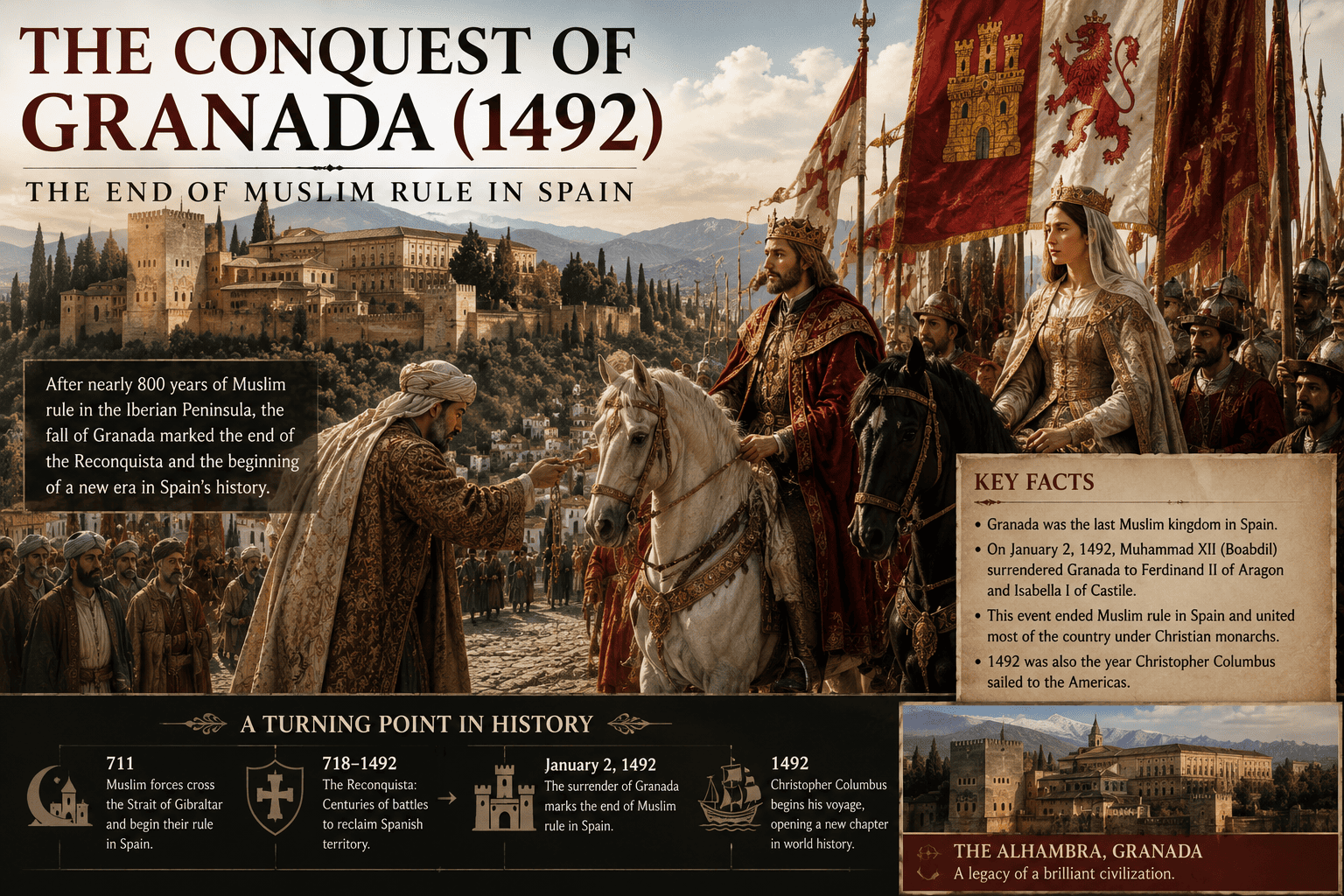
One of the most significant events in Spanish history was the Conquest of Granada in 1492. This event marked the end of nearly 800 years of Muslim rule on the Iberian Peninsula and concluded the long process known as the Reconquista.
Granada was the last Muslim kingdom remaining in what is now Spain. For centuries, the city had been a center of science, culture, architecture, and trade. One of its most famous landmarks is the Alhambra, a magnificent palace complex that still stands today.
On January 2, 1492, the ruler of Granada, Muhammad XII (Boabdil), surrendered the city to King Ferdinand II of Aragon and Queen Isabella I of Castile. This surrender ended Muslim political control in Spain and helped unite most of the country under Christian rule.
The year 1492 became a turning point in world history. In the same year that Granada fell, Spain also sponsored the voyage of Christopher Columbus, which led to the European discovery of the Americas. As a result, historians often regard 1492 as one of the most influential years in history.
The fall of Granada reshaped Spain's future and paved the way for the rise of the Spanish Empire, which would become one of the most powerful empires in the world during the following centuries.
Today, the Conquest of Granada is remembered as a defining moment in Spanish history, marking the end of one era and the beginning of another.

 Arabic
 French
 Spanish
 Portuguese
 Deutsch
 Turkish
 Dutch
Dutch
 Italiano
 Russian
 Romaian
 Portuguese (Brazil)
 Greek
Greek