
The Building of the Canadian Pacific Railway
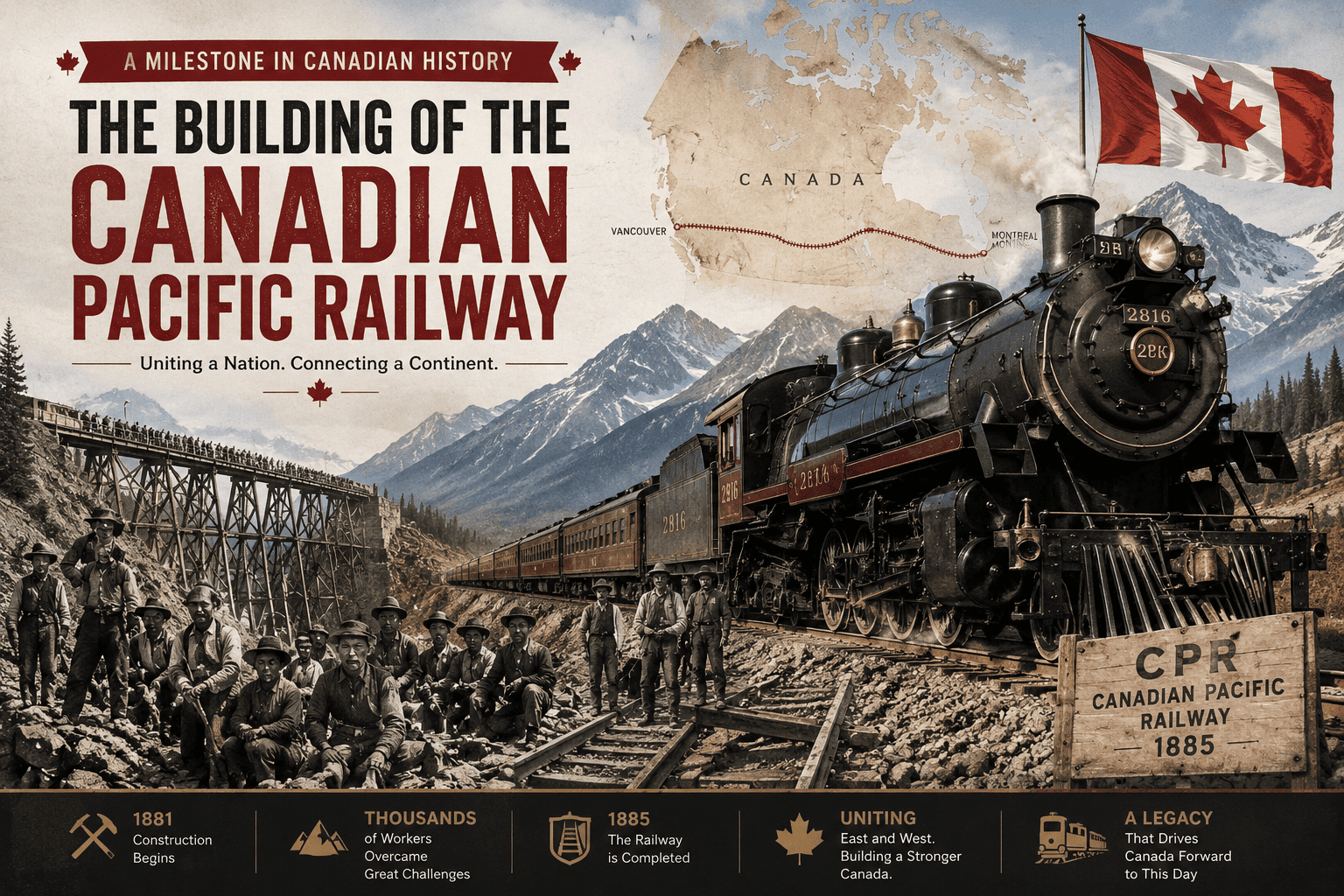
One of the most important events in Canadian history was the construction of the Canadian Pacific Railway (CPR) in the late 19th century. The railway was built to connect eastern and western Canada, helping unite the young nation after Confederation in 1867.
Construction began in the 1880s and faced enormous challenges. Workers had to build tracks through rugged mountains, dense forests, and remote wilderness. Harsh weather and difficult working conditions made the project one of the most ambitious engineering efforts of its time.
Thousands of laborers contributed to the railway, including many Chinese immigrants who played a vital role in completing the most challenging sections of the route. Their contributions remain an important part of Canada's history.
In 1885, the railway was finally completed, creating the first continuous rail link across the country. The achievement transformed transportation, trade, and communication, allowing people and goods to travel across Canada more efficiently than ever before.
Today, the Canadian Pacific Railway is remembered as a symbol of national unity, perseverance, and innovation. Its completion helped shape modern Canada and remains one of the nation's greatest historical achievements.

 English
 Arabic
 Spanish
 Portuguese
 Deutsch
 Turkish
 Dutch
Dutch
 Italiano
 Russian
 Romaian
 Portuguese (Brazil)
 Greek
Greek