
🐇 The Berlin Wall Didn't Just Divide People... It Also Created a Paradise for Rabbits
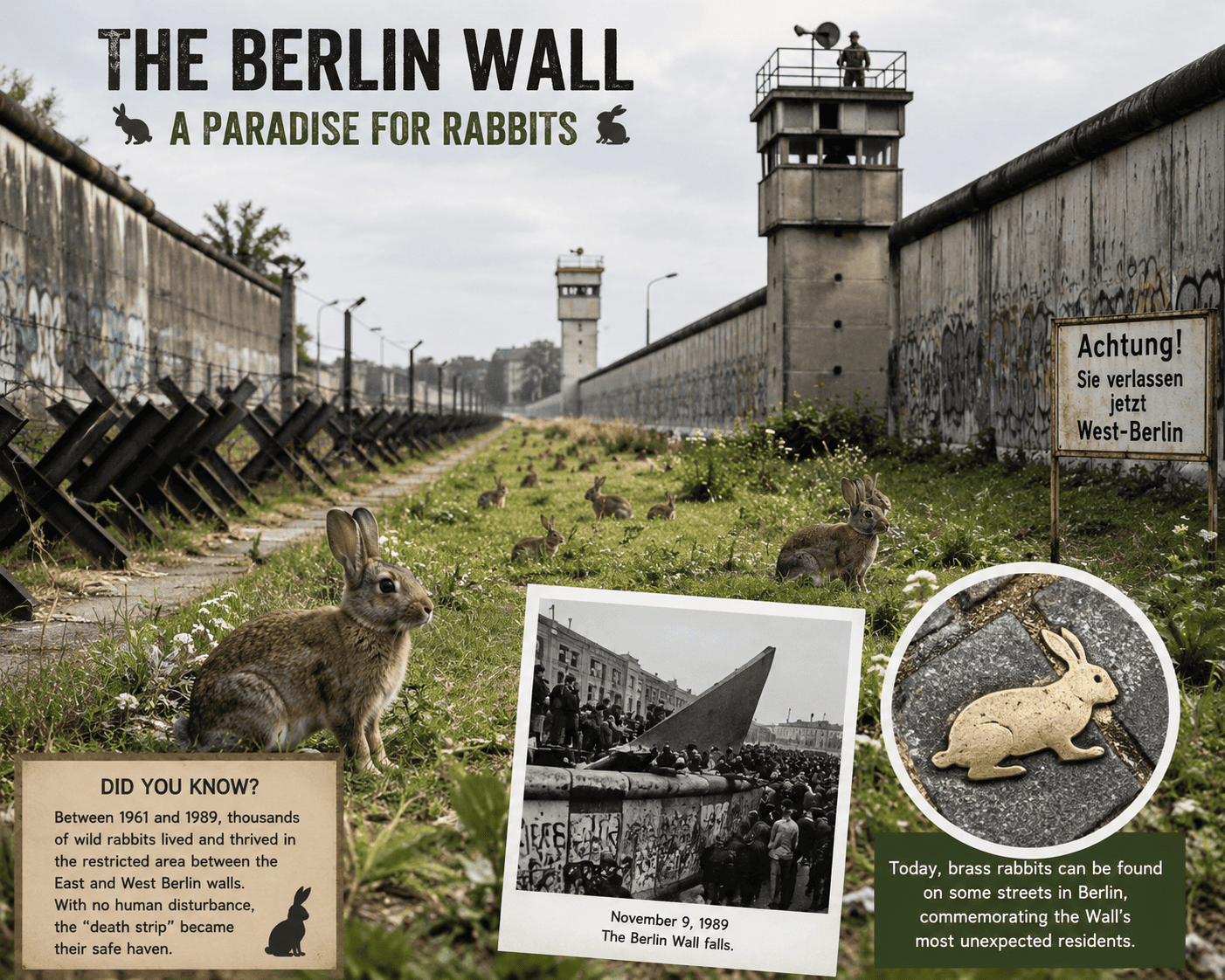
When people hear about the Berlin Wall, they usually think of the Cold War, armed guards, and a city split in two. But here's a fascinating fact that many people have never heard: the wall accidentally created a safe haven for thousands of wild rabbits.
In 1961, East Germany built the Berlin Wall to separate East Berlin from West Berlin. Between the two walls lay a heavily guarded area known as the "death strip", filled with fences, watchtowers, and obstacles designed to prevent people from escaping. Ironically, while it was one of the most dangerous places for humans, it became one of the safest places for wildlife.
Since almost no one was allowed to enter the restricted zone, wild rabbits thrived without disturbance. They multiplied rapidly, feeding on the untouched grasslands stretching along the wall. At one point, their population became so large that the tunnels they dug began affecting the ground beneath parts of the wall.
When the Berlin Wall finally fell on November 9, 1989, Germany was reunited—and the rabbits' unique habitat disappeared as well. The animals gradually spread throughout the city. Today, visitors can still find small brass rabbit plaques embedded in some of Berlin's streets, commemorating this unusual chapter of history.
The story of the "Berlin Wall Rabbits" is one of Germany's most surprising historical facts. It serves as a reminder that even the greatest political conflicts can have unexpected effects on nature, creating extraordinary stories that few people would ever imagine.

 English
 Arabic
 French
 Spanish
 Portuguese
 Turkish
 Dutch
Dutch
 Italiano
 Russian
 Romaian
 Portuguese (Brazil)
 Greek
Greek